
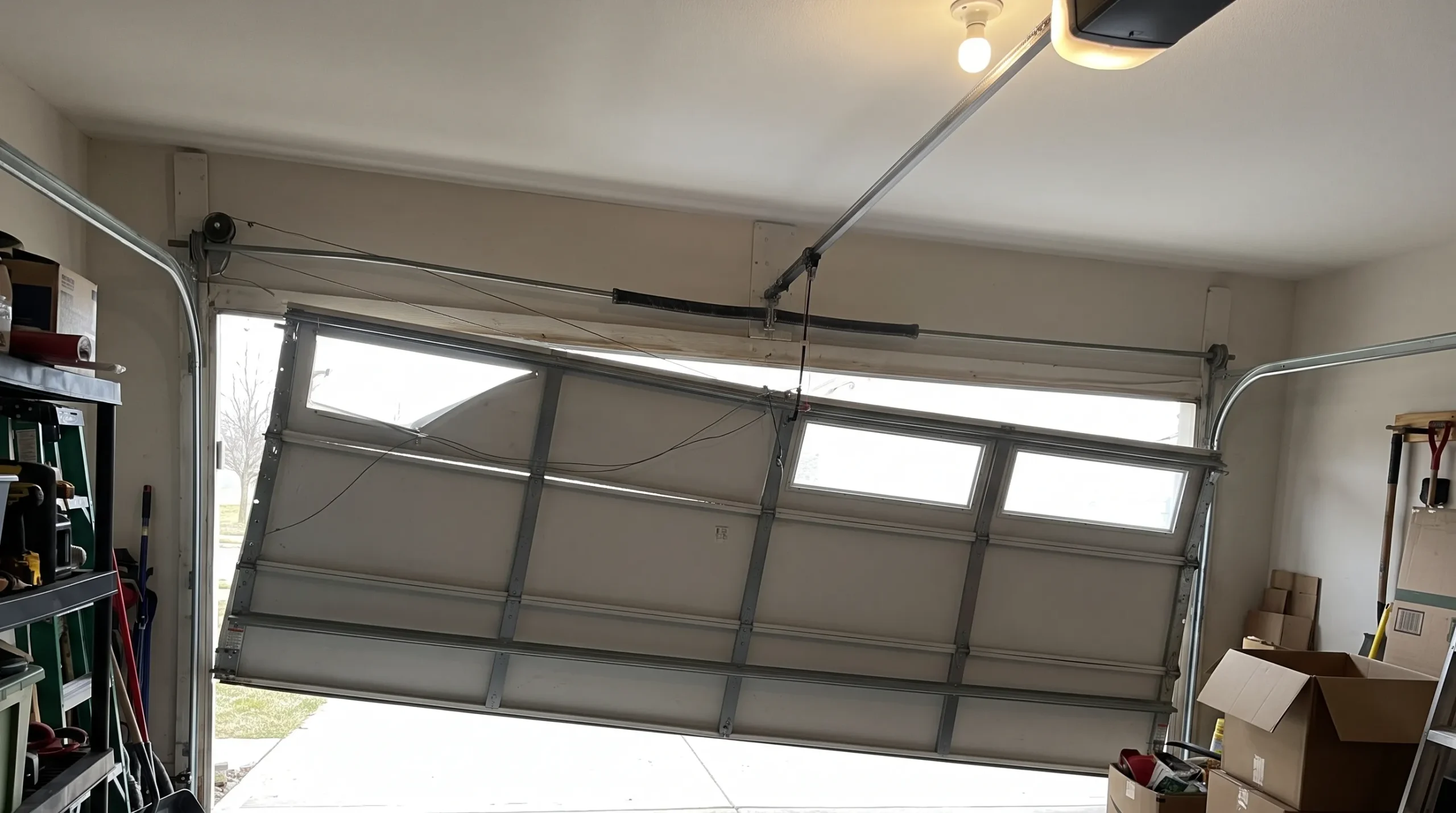
Call a professional the moment a garage door leaves its track and does not glide back into place on its own. A door off track is no longer supported the way it was built to be, which means the weight (commonly 150 to 400 pounds on a residential door, though it varies with size, material, and insulation) is being held by hardware that was never meant to carry it alone. Stop using the opener, keep people and vehicles out from under the door, and get a technician on site. The ten signs below are the ones our crews treat as hands-off. If you see any single one of them, stop and step away.
Key takeaways
- A door off track is a load-bearing failure, not an alignment annoyance. The danger is sudden movement, not the crooked look.
- Stop using the opener immediately. Every cycle attempt after a derailment makes the damage worse and can pull a second roller or cable free.
- Never touch springs, cables, or the bottom bracket. These hold the door’s counterbalance tension and can release with enough force to cause serious injury.
- If the door is stuck partway, leave it where it is. Do not prop it, do not pull it down, and do not park under it.
- Same-day service matters here. An off-track door is a security opening and a safety hazard at the same time.
- Any door that derailed after an impact needs a full hardware inspection, not just a reset.
1. The door is hanging crooked or one side has dropped lower than the other
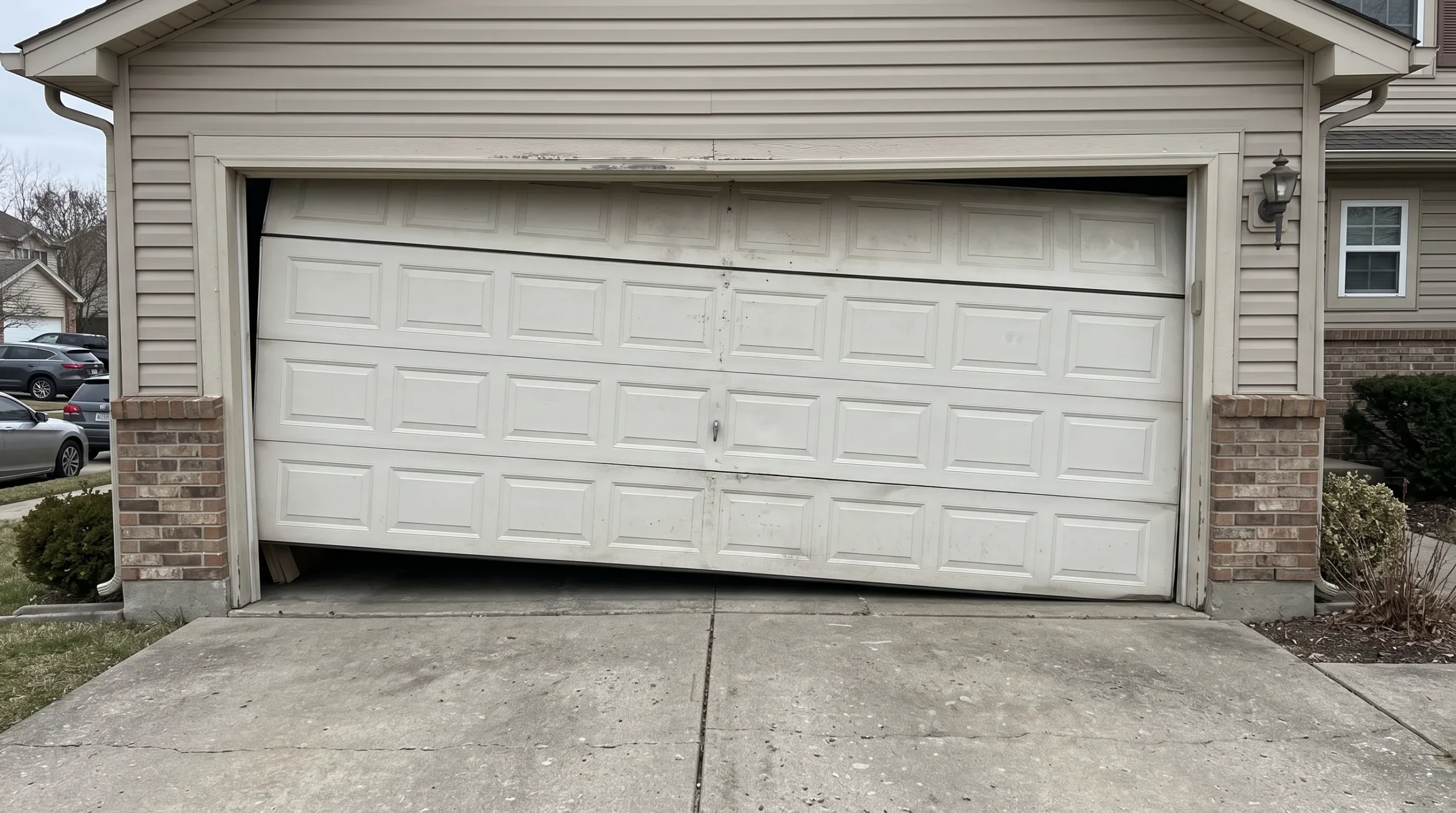
This is the most common way homeowners discover an off-track door, and it is an immediate stop. A door sitting at an angle means at least one side has lost its guided support while the other side is still held. The remaining rollers, hinges, and cable are now carrying an uneven load they were not designed for.
The usual cause is a roller that jumped its track, a broken cable on one side, or a bent section of vertical track. For the full breakdown of what causes a derailment in the first place, see our guide to garage door off track causes and safe next steps.
What to do: leave the door exactly as it is. Unplug the opener so nobody hits the wall button out of habit. Photograph the door from a safe distance for your technician and your insurance file if there was an impact.
Call a pro if the door is crooked at all. There is no safe amount of crooked.
Why a garage door hangs crooked when it comes off track
A sectional door stays square because both sides rise at the same rate, driven by matched cables under equal tension. When one side loses its cable or its roller path, that side stops rising or drops. The door then twists inside the opening and the top section takes the strain. This is why a crooked door often looks stable for hours and then shifts suddenly. The twist is holding it, and twists let go.
2. Rollers have jumped out of the track and the door is wedged in the opening
Stop here. A wedged door is under compression, and releasing it is the dangerous part, not the wedging. When rollers pop free, the door body pushes against the frame or the track lip and jams. That friction is temporarily holding weight the counterbalance system should be holding.
Homeowners often try to lever the rollers back in with a screwdriver or pry bar. That releases the jam without restoring support, which is exactly the sequence that drops a door. If you want to understand what the rollers are doing and when they wear out, our overview of garage door rollers covers it.
What to do: do not pry, lever, or hammer anything. Clear the area under and around the door.
Call a pro if any roller is out of its track, even one.
How to handle a garage door with rollers off the track
A technician reseats rollers by first taking the door’s weight off the failed side with locking pliers or a support, then releasing the jam in a controlled way, then checking why the roller left the track at all. That last step is the one DIY attempts skip. A roller that jumped once will jump again if the track is bent or the stem is worn.
3. The door is stuck partway open and will not move in either direction
A door frozen mid-travel is the highest-risk position, because gravity is doing the most work and the least is holding it back. Do not park under it. Do not walk under it to reach the yard. Do not let children or pets in the garage.
The cause is usually a derailed roller binding in the track, a broken cable that has let one side drop, or a spring failure that has left the door too heavy for the opener to hold. We cover the safety question of moving a door in this state in can you open a garage door off track safely.
What to do: get vehicles out of the path if you can do so without passing under the door panel. If you cannot, leave them. A car is cheaper than a person.
Call a pro immediately, and say the door is stuck partway. That phrase should move you up the schedule.
Why a garage door stuck off track should not be forced closed
Forcing a stuck door means adding your own force to a system whose support is unknown. If the reason it stopped is a binding roller, forcing it can shear the roller stem and drop that corner. If the reason is a broken spring, forcing it removes the friction that was holding several hundred pounds. Neither outcome is recoverable at home.
4. A cable has gone slack, come off its drum, or is hanging loose
A loose cable is a stop-immediately sign, and it is the one homeowners most often underestimate. Lift cables carry the counterbalance force from the springs to the bottom of the door. When one goes slack or unwinds from its drum, that side of the door is unsupported and the other cable is overloaded.
Never touch a cable, a cable drum, or the bottom bracket the cable attaches to. That bracket stays under tension even when the door is closed. Our post on whether a garage door cable can snap without warning explains what the failure looks like, and frayed garage door cable risks covers the warning signs that come earlier.
What to do: nothing mechanical. Keep the door closed if it is already closed.
Call a pro for any slack, frayed, kinked, or unwound cable.
What to do about a garage door cable off track or hanging loose
Cable work is tension work. A technician clamps the door, releases spring tension in a controlled way with winding bars, rewinds or replaces the cable, then resets tension and rebalances the door. Cables are also replaced in pairs, because if one has stretched or frayed, the other has the same age and duty cycle behind it.
5. You heard a loud bang and now the door feels impossibly heavy
That bang was almost certainly a torsion spring breaking, and a door with a broken spring should not be lifted, cycled, or trusted. Homeowners describe it as a gunshot or a car backfiring in the garage. The door may still look fine, then refuse to move or feel like it weighs several times what it did yesterday.
Springs are the single most dangerous component on the door. They store enough energy to remove fingers and break bones, and they are the reason we tell people to step away rather than investigate. Springs are also consumable parts, and manufacturers typically assign them a cycle rating, so their working life is finite rather than indefinite. How long a given spring actually lasts varies with the rating of the spring installed, how often the door is used, and the conditions it operates in. Our post on how long garage door springs last explains the cycle math. For the industry standards behind counterbalance systems and door hardware, DASMA is the manufacturers association that publishes them.
What to do: leave the door alone entirely. Do not use the emergency release to lift it by hand.
Call a pro. Spring replacement is never a homeowner job, regardless of the tutorial.
Why a broken garage door spring pulls the door off track
Without spring tension, the opener or the cables absorb the full door weight. A chain-drive opener will often keep pulling until one side rises faster than the other, which twists the door and walks a roller out of the track. This is why a spring failure and a derailment so often arrive in the same service call.
6. The track itself is visibly bent, twisted, or pulling away from the wall
If the track is damaged, the door cannot go back on it, and reseating rollers into a bent track guarantees a repeat failure. Look for a track that has flared open at the lip, a curve where the vertical and horizontal sections meet, or lag bolts backing out of the framing.
Track damage usually comes from an impact, from a door repeatedly forced through a bind, or from mounting hardware that has loosened over years of cycling. Our overview of garage door rails and tracks covers how the assembly is supposed to sit.
What to do: do not bend the track back with pliers or a hammer. Straightened steel does not return to spec and creates a new pinch point.
Call a pro if any part of the track is deformed or loose at its mounts.
How to fix a garage door track bent from a derailment
Bent track sections get replaced, not repaired, and the technician also checks whether the horizontal track’s hanging brackets are still square to the ceiling. A track that looks fine but hangs out of parallel will push rollers out again within weeks.
7. There is a visible gap between the door and the track, or daylight along one side
A gap means the door has already begun to leave its guided path, and the derailment is in progress rather than complete. This is the earliest sign on this list, and the one where stopping actually prevents the expensive version of the problem.
Causes include worn rollers with play in the stem, a track that has shifted at its mounts, or a door that is out of balance and riding hard against one side. The mechanics of how this starts are in why garage doors go off track.
What to do: stop cycling the door and schedule service. This is the one item on the list where a next-day appointment is usually reasonable, provided you stop using the door in the meantime.
Call a pro before the gap becomes a full derailment. Catching it here is the cheapest outcome available.
Why a gap between the garage door and track means it is coming off
Rollers need to stay captured inside the track lip through the entire travel path. A gap means the capture is marginal somewhere in that path. Every cycle is a coin flip on whether the roller stays in. Doors do not heal this on their own, and the gap always widens.
8. The opener strains, hums, or clicks but the door barely moves
Stop pressing the button. The opener is telling you the door is bound, and each attempt drives the bind deeper. An opener has a force limit, and when the door will not move freely, the motor either stalls, reverses, or grinds its gear.
The cause is a mechanical obstruction, a derailed roller, a broken spring, or a door that has gone out of balance. Openers on heavily used doors also tend to wear faster, so duty cycle is worth weighing when you spec equipment. The right rating for any given opening depends on the door, the manufacturer’s specifications, and how the opening is actually used, so published cycle tiers are best treated as planning guidance rather than fixed requirements. For a general overview of usage levels, see How Many Cycles Should a Commercial Garage Door Be Rated For? 6 Usage Levels Explained. Our post on what happens when a garage door goes off track covers the cascade from the door side.
What to do: unplug the opener. Repeated stall attempts strip the drive gear, which turns a hardware repair into a hardware plus opener repair.
Call a pro if the door does not move freely by hand after the opener is disconnected. If it does not move freely, do not force it.
Why a garage door opener strains when the door is off track
The opener only supplies the force needed to overcome friction, because the springs are supposed to be carrying the weight. When the door binds or the counterbalance fails, the opener is suddenly asked to lift hundreds of pounds through a jam. It is not built for that, and its safety reverse may not protect anyone in that condition.
9. Panels or sections are bent, buckled, or separating at the hinges
Section damage means the door has lost structural integrity, and reseating it will not restore that. Look for a crease across a panel face, a section that has pulled away from its neighbor, hinges that have torn their screws out of the panel, or a top section bowing inward.
This usually follows a derailment that was left in service, an impact, or a door cycled repeatedly while bound. At this point the conversation shifts from repair to whether the door is worth keeping, which our post on signs you need a new garage door walks through. If replacement is on the table, getting the opening dimensions right is the next step, and How Do You Measure for a New Commercial Garage Door? 8 Dimensions to Get Right Before You Order covers the process for business openings.
What to do: keep the door closed and out of service until it is assessed.
Call a pro. A damaged section can fail while the door is in motion.
How to tell if a garage door panel bent off track needs replacing
The test is whether the section still resists twisting along its length. A creased or delaminated section flexes, and a flexing section lets rollers wander out of the track no matter how well the track is set. Single sections can often be replaced on newer doors if the model is still in production, which is one of the first things a technician checks.
10. The door came off track after a vehicle impact or after being forced
Any impact-related derailment needs a full hardware inspection before the door is put back into service, not just a reset. Backing into a door is one of the more common calls we take, and the visible damage is rarely the whole story.
An impact transmits force through the sections, into the hinges and rollers, along the track, and into the mounting hardware. A door that looks like it only needs the bottom section straightened may also have a shifted track, a bent bottom bracket, or a stretched cable. For what qualifies as urgent versus schedulable, see what situations call for emergency garage door repair.
What to do: photograph everything before anything is moved, for insurance. Note whether the opener was running at the time.
Call a pro, and mention the impact explicitly so the technician arrives prepared for a full inspection.
Why a garage door off track after impact needs a full inspection
Impact damage hides in the hardware. The bottom bracket in particular sits under cable tension and can be deformed without looking deformed. Putting a door with compromised brackets back into daily cycling is how a second, worse failure happens a few weeks later.
DIY-safe versus call-a-pro: what you can actually do yourself
Task | Safe to DIY | Call a pro | Why |
Unplug the opener | Yes |
| Removes the main way damage gets worse |
Clear the area under the door | Yes |
| Basic hazard control |
Photograph the damage | Yes |
| Useful for insurance and for your technician |
Tighten a loose track lag bolt on a working door | Yes, with care |
| Low risk when the door is closed and undamaged |
Lubricate rollers and hinges on a working door | Yes |
| Routine maintenance, no stored energy involved |
Reseat a roller in the track |
| Yes | Requires taking the door’s weight off first |
Straighten or replace track |
| Yes | Bent steel must be replaced and re-squared |
Any cable work |
| Yes | Cables are under counterbalance tension |
Any spring work |
| Yes | Highest injury risk on the entire door |
Bottom bracket adjustment |
| Yes | Stays under tension even with the door closed |
Panel or section replacement |
| Yes | Structural, and requires door rebalancing |
Post-impact inspection |
| Yes | Damage is frequently hidden in hardware |
If the door off track is at your business, the stakes are different
A derailed door at a warehouse, shop, or loading bay is a production stoppage and a security opening, and commercial hardware carries more weight and more stored energy than a residential door. The same rule applies, only more firmly: stop cycling it and get a technician out. Commercial doors also come in configurations that fail differently, so the repair path depends on what you have installed. Our commercial garage door service covers all of them, including the commercial sectional door, the grill roller door, and the sheet metal door.
There may be a compliance layer too. Depending on the building, its occupancy, and where the opening sits, a commercial door can fall under fire-rated assembly requirements, entrapment protection standards, or state and local building code provisions that a residential door never touches. What applies varies by project and by jurisdiction, and your local Authority Having Jurisdiction makes the final determination. Published code text is available through the ICC digital codes library. If your door is fire-rated or sits in an exit path, treat a derailment as a possible code matter as well as a repair matter, and confirm what applies with your AHJ before the door goes back into service. For more background, see Does Your Commercial Garage Door Need to Meet Code in California? 7 Requirements to Check.
The bottom line: an off-track door is a stop, not a project
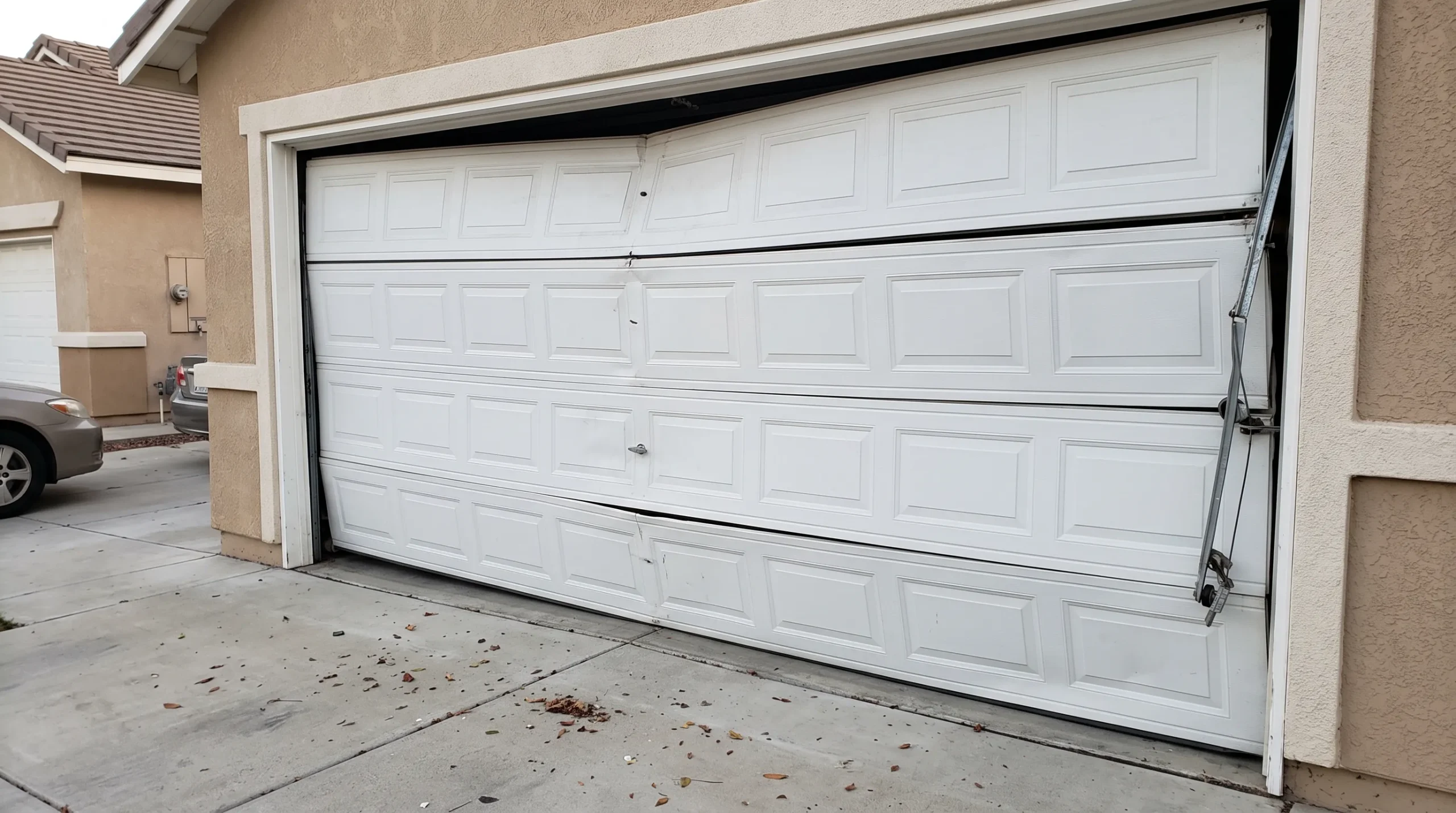
Every sign on this list has the same instruction behind it, which is that a garage door off track has lost the support system that makes it safe to operate. The crooked look, the stuck position, the loose cable, and the loud bang are all versions of the same underlying condition. Nothing about it improves with another press of the button, and most of the expensive repairs we see started as a cheap repair that got cycled a few more times.
If your door is off track in Yuba City or anywhere in the surrounding Sacramento Valley, R&S Overhead Doors of NorCal can get a licensed technician on site, often the same day. Book same-day garage door service or request a free quote. Tell us the door is off track when you call, because that moves you up the schedule.